Sunday, June 17, 2012

Salento

For those travelers who love to chill in quiet little towns, check out one of my favourites in Colombia - Salento.


Situated in Colombia's La Zona Cafetera, a coffee growing region, Salento is actually a very popular tourist town. However, as it is very popular for local tourists, the "crowds" mainly come in during the weekends (and public holidays). Nevertheless, the town retains its laidback charm, and nestled in a plateau giving beautiful views over the surrounding valleys, as well as access to the Cocora valley, it is a great place to stop and relax.

For me, aside from the laidback lifestyle, two main factors helped made this one of my favourite places. The climate as well as coffee! Salento is situated at an altitute of about 1900m above sea level and boasts an average annual temperature of 15 °C, so it is really pleasant to walk around to soak in the views. And you could get a wonderful cup of machine-pressed Colombian coffee for just 50cents! Not to mention value-for-money menu del dias (lunch/dinner sets) in town! Gotta love those local trucha (trout)!!


Aside from trips to the Cocora valley, tourists can easily walk from town to a mirador (viewpoint) that provides stupendous views of the surrounding valley. The town also have certain architecture typical of that region and shops selling locally made handicrafts. And of course, you can take tours to nearby coffee plantations!


So if you have the time in Colombia, do check out Salento!


Saturday, June 9, 2012

Huayna Picchu

While most people would be aquainted with Machu Picchu, less would be familiar with Huayna Picchu (also known as Wayna Picchu). But Huayna Picchu will, quite literally, bestow a different view of Machu Picchu to you!

Huayna Picchu is the mountain peak that towers over The Lost City of the Incas. It is that tallest peak as seen in the many iconic pictures of Machu Picchu (the big "nose" of the face, if you know what I mean). Access to Huayna Picchu is restricted to only 400 visitors per day, split into 2 batches of 200 each, on a first-come-first-serve basis. The climb up is narrow and steep, so I guess this is a good arrangement. 


So together with other visitors who wanted to climb Huayna Picchu and were afraid that we could not get within the allowed number, we were at the gates at the base of Machu Picchu way before it opened. The moment the gates opened (5.30am) it was a mad race up to the Machu Picchu entry gate (where the Huayna Picchu "ticket" is issued). This is to ensure that we would be there before the first bus from Aguas Calientes reaches! But apparently, from what I gather, advance reservation is possible together with the purchase of your Machu Picchu ticket! Anyway, it was an exhilirating (albeit tough) early morning exercise!

After the strenous climb just to get the Huayna Picchu entry ticket, the climb up Huayna Picchu itself can be done at your own pace of course. Not a walk in the park but definitely manageable. At the peak, you can also visit some caves and temples but the views are what I climb for! From the summit, you can see the entire Machu Picchu in its full glory (as well as the the zigzag road up from Aguas Calientes). The Incas built the city in the shape of the condor, and one could only see it from a high enough vantage point! Can you see it?


Also, supposedly, old Cusco was built in the shape of a puma, and Ollymtambo was built in the shape of a llama! I was at a high vantage point in Ollymtambo but could not quite make out the shape. I supposed these towns/cities are expanding living sites, so the old shape may not be there anymore. Or maybe, you would need an almost aerial view to see it. But make the effort, and from Huayna Picchu, you could still make out the condor that is Machu Picchu!

Saturday, June 2, 2012

Lares Trek

One of the highlights of a trip to Peru is undoubtedly Machu Picchu, and the classic way to reach this wonder is via the Inca Trail. However, as the Inca Trail requires special permits and a controlled number of trekkers are allowed on it, advanced reservations are often advised and this may hamper those who's travel itinerary are just planned out a day in advance......


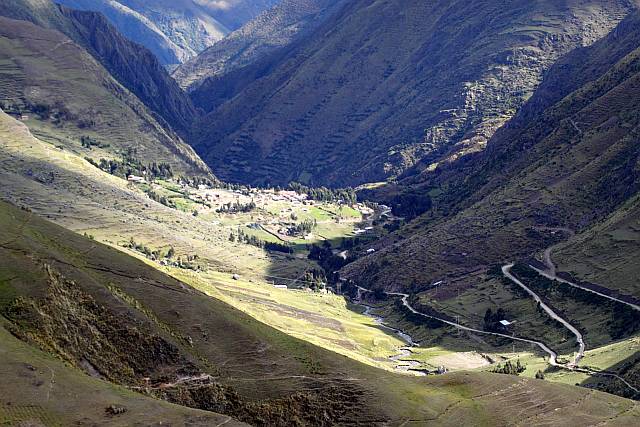
However, there are a number of alternative treks that one could enjoy from Cusco to Machu Picchu. I took the Lares Trek, and really enjoyed it (except the last day). There are a few variants of this trek itself, and the last day of our 3-day trek variant was on a vehicular dirt road, which was not exactly the best of trekking experiences. Still, it was overall a good outing, especially the first 2 days, which were absolutely fabulous!

The highlight of the trek for me, is the campsite stop in the village of Huacahuasi. An Andean community still living in old stone thatched houses, complete with villagers donned in their colourful traditional attire, it was a good glimpse into a distant past. These villages are also known for their weaving, and so, getting a handwoven llicilas/manta/poncho would be a real deal vs getting something in the city of Cusco. And camping and sleeping under the blanket of the Milky Way is always something special. The trek itself was not exactly strenous although the altitude would slow you down, with the highest point being over 4000+m. Nevertheless, just take it slow, and stop and admire the beautiful Lares valley and its inhabitants!


The trek ends in the town of Ollantaytambo, where a train ride will bring you to Aguas Calientes where you would explore the wonderful Machu Picchu. A fitting end to a wonderful trek indeed!

Wednesday, April 25, 2012

Jindo Miracle Sea Festival

Once a year in Jindo, one of many islands off Mokpo in the province of Jeollanam-do in South Korea, a festival would take place that would seem of biblical proportions. Known as Jindo Miracle Sea Festival, or Jindo Sea Parting Festival, the seas would part to reveal a road leading from Jindo to a neightbouring island.


While also known as the 'Moses Miracle', local legend instead tell of an old lady who was somehow left behind when the other villagers in Jindo fled to the neighbouring island because of some wild tigers. She prayed to the Sea God who then parted the sea for her to join her family. The phenomenon though, divine or not, actually happens 2-3 times a year, when the tide is at its extreme lowest, revealing a land bridge of sorts that actually connects Jindo to that particular island. The Festival though, was to be held only once a year (well to make it special I guess), and during then, you could join in the festivities and walk the 2.8km land bridge to the island.


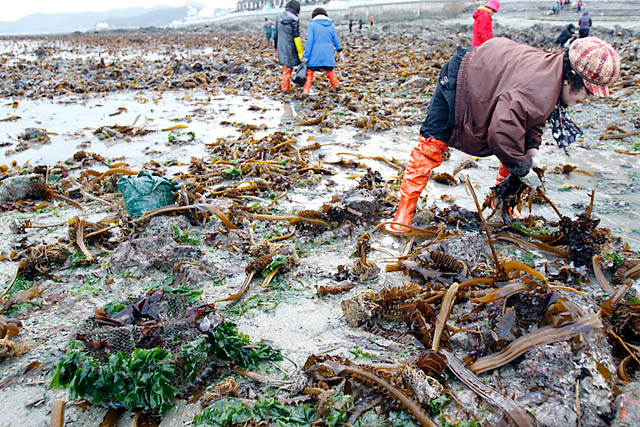
Like many festivals in Korea, a carnival of sorts are almost mandatory, complete with food tents, music and performances. Once evening descends (approx 5pm), when the sea "parts" for an hour or so, the locals spring into action - no, not to cross the parted sea, but to scour the land!! This is something definitely more down-to-earth - free seafood for the masses! From seaweed to mussels, from crabs to abalone, families comb the land bridge for the riches of the seabed. No doubt what sort of dinner these families are having for the week... What a sight!


There are express buses from Seoul to Jindo which takes about 5hrs, and there are direct ferries from Jeju to Jindo too. However, for those who would want to enjoy the festival or event longer, it may be a good idea to stay in Mokpo, which is easily accessible via train from Seoul as well. Mokpo to Jindo is just 30minutes by bus. There are a couple of accomodation options in Jindo too, but as the Formula One race had arrived in Mokpo some years back, the upgraded motels in Mokpo seemed very well valued with excellent in-room facilities at affordable prices (we had a luxurious twin room for 55,000 won).

For those who have yet to experience a "miracle", check out Jindo's Miracle Sea Festival! ;)


Monday, April 2, 2012

Nemrut Daği

There are some places that just exudes a sense of mystery, or a fascinating past, and one of the main attractions of eastern Turkey - Mt Nemrut or Nemrut Daği, is such a place. Discovered in 1881, and declared a UNESCO World Heritage Site only in 1987, it is certainly one of the highlights of Turkey, and some would say, the star attraction even.


A tomb site of a king atop a mountaintop may not seem out of the ordinary, but the statues surrounding the site are the talking point. King Antiochus I, King of Commagene, believed himself equal to the gods, and thus have his own statue made seated together with the likes of Zeus, Apollo and Hercules etc. Somehow, somewhere in time, these statues got beheaded, and now what's left is a scene of headless statues seated in a row, with their heads staring out from somewhere below their feet. And these statues are huge - the heads alone are man-sized! The statues are also placed on both the eastern and western face of the mountaintop, and so, many tourists come up not just to see this eerie sight, but for sunrise and/or sunset viewing as well. And yes, the views are stunning indeed!


There are supposedly 2 routes to the site - Malatya from the north, and Kahta from the south (and not to be confused with another Nemrut Daği near Lake Van at the very eastern end of Turkey). Travel arrangements can be made at both cities. Package tours (typically from 3D2N to 4D3N) are also available from as far as Cappadocia, with a evening/sunset stop atop Mt Nemrut. There are also supposedly some accommodation options in the nearby village but is practical only for those with their own car. Arrangement can be made to stay overnight at the cafe/restaurant at the entrance of the site too (which I did), and then you can catch both the sunset and the sunrise. Bring a good sleeping bag, and you can watch the stars on the restaurant verandah too! Note that you need a half hour hike up a barren rocky path to reach the statues!

There are many many places in the world for watching a glorious sunset/sunrise. But not together with a bunch of beheaded statues... and their heads!


Saturday, March 31, 2012

Earth Hour 2012

Yes, today is Earth Hour, and it's happening 8.30pm in the time of your respective home country.


Will there ever be a possibility that a city participate in Earth Hour such that the whole city is plunged into darkness, and then the heavens will reveal itself in its full glory!


When its dark enough, you can see the stars. -- Persian Proverb


Saturday, March 17, 2012

Three Great Festivals of Tohoku

Summer in Japan is humidly hot, especially on the main island of Honshu, but it is during this season where there are tons of festivals about. Thus on my overland journey from Hokkaido (which is really pleasant for sightseeing in summer) back to Tokyo, I managed to catch the Three Great Festivals of Tohoku - Aomori's Nebuta Matsuri, Akita's Kanto Matsuri and Sendai's Tanabata.

Aomori's Nebuta Matsuri is held from August 2-7, and consists of a parade of music and dances, with the highlight being the huge graphic lantern floats. These paper lantern floats are fantastically detailed, depicting the gods and demons of Japanese/Chinese culture. They are mounted on a huge wheeled platform, and pushed and spun about by a contingent of energetic enthusiastic men. These floats supposedly take a year to design and build, and looking at the artistry, it's not hard to believe!


Akita's Kanto Matsuri is held from August 3-6. The highlight of the festival is the balancing of kanto - bamboo poles adorned with paper lanterns. The performers do that sequentially using 4 methods - on the palm, forehead, shoulder, and hip... all using one hand! During the day, competitions are held with teams and individual events, accompanied by drums and music. During the night parade, the streets are lined with these kantos, and the lanterns lighted with real candles. On a single signal, all the kantos are hoisted up and a mass display of skill occurs. Amazing sight!


There are many Tanabata festivals in Japan, but Sendai's one of the biggest and most famous. Also known as Star festival, it is based on the Chinese legend about the cowherd and weaver girl which is held on the 7th day of the 7th lunar month. However, due to calendar differences, different Tanabata festivals are held on July as well as August. Sendai's Tanabata is held on August 6-8. Basically, the whole city's shopping streets and arcades will be decorated by these long paper streamers, designed and made by just about any local organisation (schools, shops, communities, groups etc). Aside from these decorations though, this festival appears relatively uninteresting as compared to the other two. There are, of course, performances, music & dances and various points in the city.


There are lots more other festivals scattered across the country, and the most wonderful aspect of the festivities is that, everyone turns up in their traditional attire, and seeing all those kids all dressed up really makes them soooooo kawaii!! :)

Aside from the heat, it's great fun!!