Wednesday, January 30, 2013

Kutná Hora

For visitors to Europe, churches, cathedrals and chapels are common sights and many are attractions in their own right. But perhaps one of the most interesting and unique chapels I've visited lies in the Czech Republic.


In the town of Kutná Hora, there is a small chapel known as the Sedlec Ossuary. Centuries ago, an abbot from a monastery returned from Golgotha (a holy site in Jerusalem) with a small amount of earth which he sprinkled over the grounds of the abbey cemetery. News soon spread and the cemetery became a very popular burial site. On top of that, the Black Death plague at that time resulted in even more burials in the cemetery. Further down in history, a church was built on the cemetery grounds and a chapel beneath it. During the construction, all the bones from the graves had to be exhumed, and the chapel was then to be used as an ossuary. So what was so special and unique about all this?


Well, in 1870, a woodcarver named František Rint turned all the bones in the ossuary into an unbelievable piece of art. The whole interior of the chapel is now decorated by bones - in fact, some of the furnishings are constructed by these bones (and skulls). Notably, there is an enormous chandelier made entirely of bones, and it's supposed to contain at least one of every bone in the human body! All in all, an estimated 40,000 people's bones are now used inside the chapel.


Kutná Hora itself is also worth a visit as its town centre is also a UNESCO World Heritage site. Most famous is the Church of St Barbara, with its impressive spires and beautiful interiors. It is easily reached via train or bus from Prague, and so, can be done just with a day trip.

Do check it out when you visit the Czech Republic. Highly recommended!

Saturday, January 19, 2013

Beautiful Light in Bagan

For visitors to Myanmar, Bagan is a definite stop in the itinerary. For visitors who are avid photographers, Bagan is a dream stop in the itinerary. And for me, the best stop for landscape photography!


Bagan is an ancient city on a site containing over 2000 temples, pagodas and stupas. During its heyday as the capital of the Kingdom then (11-13th century), there were as many as over 10,000 temples etc. Now, while majority seems to be in a state of ruins, many have been restored and maintained. For those interested in the historic and cultural aspects of Myanmar, the temples provide fascinating glimpses into Buddhism in this part of Asia.

What captivated me however, is the golden light during sunrise and sunset. Cast onto the dusty and misty plains, and dotted with the spires of the pagodas and temples, the scene is stupendous. There are a couple of ways to tour the sites. Most backpackers would hire bicycles to visit the attractions. You could also hire a car or a horsecart for the whole day. For photographers who want to catch the sunrises and sunsets (yes you should!), the latter is recommended. Especially if you want to take the sunsets from some temples that are off-the-beaten-path. The roads there are bad, and after sunset, it would be completely dark and cycling at those conditions are certainly not recommended. In fact, some horsecart drivers were also reluctant to go to some of the further temples for sunsets. Remember to check with your drivers! The most common site for sunset viewing is probably Shwesandaw but I went to Pyathada (which is more remote). For those who have a little more budget, you could also have sunrise viewing and photography atop the hot-air balloons! I would imagine the scene would be absolutely fabulous!


And even back in Nyaung U town, the morning light provided wonderful ambience to the local market. Go between 7.30am - 8.30am, and with the tree foliage around the market area and the dusty air, the resultant light rays add plenty of opportunities for good composition!


As mentioned earlier, Bagan is one of Myanmar's top attractions. So there are plenty of options to get to Bagan, from buses and rail, to air and boat! And there are 3 areas for acommodation options - Old Bagan, New Bagan, and Nyaung U. The latter is where most of the budget options are. Whichever the options, Bagan is my favourite sunrise/sunset location in Myanmar!

Saturday, January 5, 2013

Taunggyi Fire Balloon Festival

Taunggyi, the capital of Shan State in Myanmar, and a transport hub for travelers to Inle Lake and Nyaung Shwe, also plays host to one of Myanmar's biggest and rowdiest festivals - the Fire Balloon Festival!


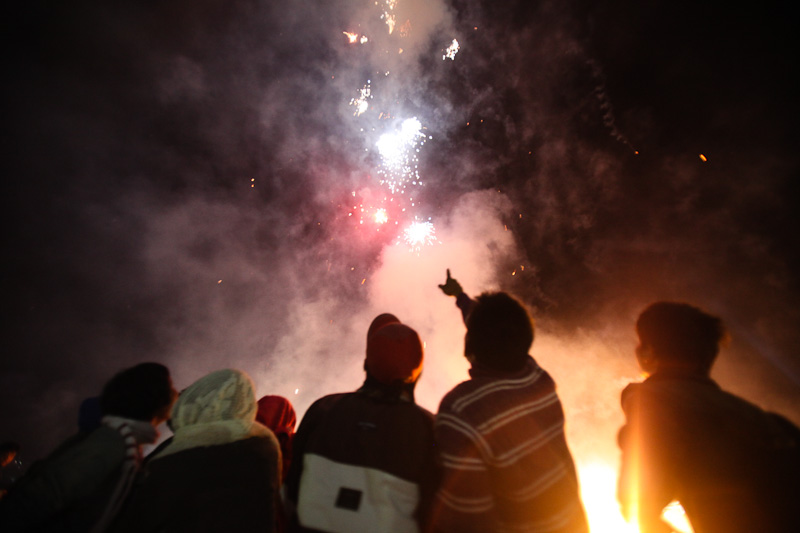
Held annually, usually in November, and lasting a week to coincide with the full moon day, the festival attracts hordes of visitors from all over the country. In 2012, the festival was held from 21-28 November. During the festival, contests are held whereby huge balloons are constructed by teams from associations and groups from neighbouring towns etc, to compete in 3 categories. In the day, the balloons take the form of dragons, elephants, pagodas etc, but I'm unclear how the judging is made - presumably on how ornate the balloon is designed (note that these balloons are huge!). However, it's at night where the competition heats up (literally)! The balloons are generally huge oval-shaped hot-air balloons, carrying a basket full of carefully arranged fireworks. These balloons are launched by their respective teams, and when the balloons are in the air, the fireworks are released systematically. The balloon that goes up the highest, and with the most spectacular fireworks would be judged the best! Finally, there is another category where the balloons would be decorated with candle-lighted designs. The candles are lighted and placed onto the balloon only during launch, and requires quick and organised coordination by team members.

And while all these are going on, the festival grounds is one huge carnival. Lanes and lanes of makeshift foodstalls compete for attention. Carnival favourites like the merry-go-rounds and ferris wheels take up substantial portion of the area with frenzied activity - they are all human-powered, even the ferris wheels! To complete the festivities, another huge area is set up as a concert ground, where live bands and singers perform for the night. No doubt one of the biggest festivals I've seen.


However, a few notes of precaution. Myanmar's tourism infrastructure is still struggling to cope with its recent influx of tourists, let alone such a hugely popular festival with the locals. So accomodation options are extremely limited for foreigners (esp budget ones). The nearby town of Nyaung Shwe has more accommodation options since it is the access town for Inle Lake. Even then, its limits were tested. I could not find any accommodation when I arrived and had to settle for some floor space on monastery grounds. Transport between Taunggyi and Nyaung Shwe were limited to private taxis as public transport does not quite get to the festival grounds, and the festival lasts till past midnight. And finally, even as alot of fire was involved in the celebrations, I'm sure the festival would not pass any safety awards. As the balloon rises into the sky, the pyrotechnics spewing down onto the festival ground is as exciting as it gets. Your run for cover during paintball games is literally kids play compared to this! And then there's the bad news. Not all the balloons have successful flights... some do come crashing down................... 

Nevertheless, everyone is out for good fun as evident by the turnout. A definite highlight on my trip to Myanmar!

Saturday, December 22, 2012

Gokteik Viaduct, Myanmar

Northern Myanmar is one of the lesser visited parts of Myanmar, and I barely scratched the southern tip, but scratched I did, and one of the highlights was the journey through the Gokteik Viaduct.

The Gokteik Viaduct is a railway bridge/trestle about 100km north of Mandalay, and at the time of its completed construction (1901), the highest/biggest in the world. It is currently still Myanmar's biggest/highest at over 100m high and almost 700m long. Creaking slowly and loudly over this metallic wonder is the train plying between Mandalay and Lashio.


However, I didn't venture till Lashio (from where you could then go further north into China), but visited Hsipaw instead, which is a delightfully laidback Shan state town. The north-bound train from Mandalay starts at 4am, so I took the bus instead to Hsipaw (and enjoyed a couple of days there) and experienced the viaduct via the south-bound train, which was scheduled to roll into Hsipaw at 9am. Trains in Myanmar are notoriously slow and unpunctual, though, and mine arrived nonchalantly at 11am. It was also the bounciest and rockiest train ride I had in my life. The sway and bounce were of such magnitudes, it would probably register a 9 on the Richter scale.

And it would be another 4+ hours before reaching the Gokteik Viaduct. The stationmaster at Hsipaw station was certainly familiar with our tourists needs, and had assigned seats for tourists on the right side of the train for better viewing as we cross the viaduct (remember this is the southbound train). And there were no worries about missing the views - as the train nears the crossing, there would a certain bustle in the carriage as the train conductor, if not the locals, would arouse us into position. The train would rumble straight into a tunnel right into the mountain, and slowly emerge onto the metal monstrosity. Then, slowly and laboriously, with curioius heads all sticking out of the train windows, the train crawled across the bridge. The bridge looked solid enough, but the sprawling lush green gorge below does quicken your heart rate a notch or two. But savour the views and spectable, for after the crossing, it would be another 3-4 hours to the next stop of interest - Pyin Oo Lwin.

Train going into a tunnel through a mountain before crossing the Viaduct

The tunnel in the mountain!
Crossing the Gokteik Viaduct!

The Gokteik Viaduct

While the train eventually does get into Mandalay, it also makes a ridiculously long stop at Pyin Oo Lwin, a hill resort town that many would recommend a night or two. So the wise would often alight at Pyin Oo Lwin where there would be many pickups going to Mandalay. The difference would be reaching Mandalay at 7-8pm vs midnight if continuing on the train.

From Hsipaw to Pyin Oo Lwin, an ordinary class seat (a wooden bench) costs US$3 while a upper class seat (cushioned seat) costs US$6. The train looked as if it had not had any maintenance since it started operating, but this is easily forgotten once you get to the bridge (I hope!). If you want to experience only one train ride in Myanmar, this would be the best bet!

Local activity at one of the station stops
Apparently, the train is also the mail train and he is the mail man!!

Saturday, November 24, 2012

Kurama Fire Festival

October 22 is a good day to be in Kyoto. Aside from the famous Jidai Festival, there is another interesting festival held on the same day - the Kurama Fire Festival (Kurama Hi Matsuri). While the Jidai Festival is held during the day, Kurama Fire Festival happens in the evening, so you get a full day of activities!

The Fire Festival however, is held in the village of Kurama, 30-45 min away from Kyoto by train. The village itself, is a delightful "traditional wooden houses" village, and makes for a good visit on its own. The festival is a ritual where huge pine torches are used to guide spirits between the realm of the living and the dead. It begins at 6pm where the houses in the village would light up with watch fires at their entrances. Then the local residents would get their young children to bear small pine torches and conduct a procession ceremony through the village chanting "Sai rei ya, Sai ryou" (which means "festival, good festival!"). Subsequently, the men (in traditional costume of loincloth and a strange half-shirt) would do similar, with huge pine torches, some weighing 100kg! Two portable shrines are then paraded through the streets and eventually, enshrined at a place called "Otabisho". On October 23, another ceremony takes place where these portable shrines are then taken down and enshrined at the Yuki jinja shrine.

Festival start off with young children bearing small pine torches
The adults carry a much bigger torch!!
It's heavier than it looks! And note the interesting attire they are wearing
Starting procession with portable shrines

A few notes and information to people (esp photographers) making a trip to see the festival.
- Aside from the fires, there are very little other lighting. So generally, there will be big differences in lighting in your scenes.
- Due to the crowds, the whole site is heavily policed with very restricted lanes for tourists to move in. You will be literally herded in a "path" designated for tourists.
- This festival is a traditional local festival - it is not something designed for tourists. So bear that in mind. While you may want to capture a promising frame, respect the people and festival, and not interfere/interrupt the procession. Moreover, it's very chaotic, smoky, and fires burning everywhere, so safety is important.
- A tripod is not practical for this festival (esp the limited space) though a monopod may be useful.
- There will be ALOT of waiting. Right from the start at Kyoto. At Demachiyanagi station on the Eizan Railway in Kyoto, I arrived at 5pm. The queue was spilling out of the station, and I waited till 6.45pm before I could board the tiny local train to Kurama. The festival runs till 12 midnight, and after 8pm, the frequency of trains back to Kyoto was also reduced. So similarly, I had to wait more than an hour for the train back, boarding my train at 10+pm.
- Due to the crowds and the limited space in the village and the designated tourist "lanes", sometimes you could get stuck in the "queues" for 10-20 minutes without moving!

So, if you are very adverse to crowds in smoky environment, or have little patience for waiting, then perhaps you have to think twice about this festival. Other than that, the Kumara Fire Festival is certainly one of the more interesting festivals in Japan!

Saturday, November 17, 2012

Oirase Stream, Tohoku Japan

When I was researching my autumn trip to Japan, one of the places that was really popular was Oirase Stream in Tohoku. So I decided to head over to take a look.

Autumn foliage over pretty mountain stream

Oirase Stream is a mountain stream in Aomori prefecture, with water flowing from Lake Towada. There is a hiking trail running almost parallel to the stream, but unfortunately, a vehicular road also runs almost beside the hiking trail!! This is also the access road where the major cities of Hachinohe and Aomori connects to Lake Towada, so it can get busy. However, it is still well worth an outing, especially if you are a photographer who loves "flowing water among foliage" photos!

As it turns out, the foliage in most parts are actually quite thick, such that when you look at the pictures, it's hard to imagine that a road is just 5 metres behind you! Moreover, with the thick foliage, you could get beautiful sunlight streaming through the trees, and in most cases, provide enough cover so that you could slow down your shutter speed to achieve the silky smooth flowing water effect of the streams and waterfalls.

Some parts of the hiking trail unfortunately "spill" over to the road
Hard to tell that these scenes are just beside a busy road!
Besides hikers, there are many artists as well!

My main gripe as a solo backpacker is the access. Unless you have a vehicle, you will be at the mercy of the public bus schedules. There are buses from Aomori and Hachinohe that goes to Yasumiya (the access town of Lake Towada) that passes through the road beside the trail. There are a number of bus-stops along the way, and hence you can opt to only do partial parts of the trail or all (the whole trail is 9km long). Unfortunately, the last bus back to the city was like 4pm which I felt was way too early. Also, the bus fare is ridiculously expensive - a 1-way fare from Hachinohe to the extreme end of the trail (Nenokuchi) is 2000yen (~us$25)!

Nevertheless, the place is very pictureque! (hopefully evident in the photos :p) The best parts of the trail (with flowing water over rocks and foliage) is probably at Ishigedo. For those with enough budget, there is also a hotel at Yakeyama, which is the other end of the hiking trail, so you could have the hiking trail for yourself at later parts in the day (yes, it gets really crowded!). If you drive, you also also base yourself at Lake Towada (Yasumiya).

All in all, well worth a trip!

Beautiful light, beautiful waterfall

Sunday, October 14, 2012

Sighnaghi, Georgia

The Kakheti region in eastern Georgia is well-known as a wine producing region, and in fact, some say that it is the cradle of the world's wine production! And one of the more popular destinations within the Kakheti region is the hilltop town of Sighnaghi.


In fact, after some heavy reconstruction efforts from the government, it has become a very popular and important attraction for both locals and foreign tourists alike. And it is hard not to like the small town. Beautiful houses with ornate balconies built between neat pictureque cobbled streets, and surrounded by breathtaking Caucasus mountain ranges, it was holiday-picture-perfect. Add to it the wonderful Georgian cuisine, complete with its famous wines, all at affordable prices, really, it was one of the best places to relax and unwind.


Churches, monastery and monuments form most of its attractions, all within easy reach from town. The most famous is its 18th century town wall that stretches 4.5km, one of the longest in the world. Sighnaghi was a fortified town during its time, and the wall contains 35 towers each named after a nearby village, and each offering refuge for the villagers during times of war. The churches and monastery, like most in Georgia, all all worth a visit, though at that time (Kakheti was the last region I visit in Georgia), I may already had an overdose... :p


While the town have fancy hotels and restaurants, and even pretty boutique hotels, I stayed in a beautiful family-run guesthouse (Nato & Lado) that suited my budget. Aside from their amazing hospitality, their homecooked dinner with free-flow homemade wine were phenomenal! Truly one of my best stays in Georgia!

Sighnaghi is easily accessible from Tbilisi by mashrutkhas like everywhere else in Georgia. Just about 2 hours of journey, and you'll be transported to a wonderfully refreshing destination....