Showing posts with label desert. Show all posts

Sunday, January 25, 2015

Dallol & the Danakil Depression

After visiting Erta Ale, the next highlight of the Danakil Depression is equally surreal, and no less easy to visit - the salt mines and sulphur springs of Dallol.

This time, our base is the "village" of Hamed Ila that consists of more of the rickety "tree-branch" huts that is common in the Afar region. Like the night in Erta Ale, sleeping options were just "safari beds" - outdoor collapsible camping beds, which was laid out outside the hut. It would be much cooler to sleep in the open.

The Afar homestead, and the only accommodation option (though we slept outside)

Again, military escorts were brought in, and the visit to the sulphur springs was first. This time, we were driven barely an hour and then it was "only" a 30-40 minutes walk to the site. But it was a walk through a broken land of sharp rocks, bizarre-shaped formations, and soul-sapping heat. I had brought a 1-litre bottle of water along and it was barely enough.

The yellow-brown-stained landscape is an eye-opening sight. I had thought the Bolivian Altiplano desert to be unearthly but the scene here is downright alien. Bubbling pools of  yellow-white sulphuric acid smear the reddish-brown hardened ground, with pockets of greenish mineral ponds and ghastly weird protrusions scattered throughout. Admiration of the scene though, was somewhat marred by the suffocating sulphuric air (even with a face mask) and the constant heat. So remember to bring a good face mask and plenty of water! I was on the verge of a heat-stroke on return to our vehicle!

Military escort vehicle leading us through broken and used land - this used to be covered with salt!!

Short hike to the sulphur springs

Alien landscape

Alien landscape
Sulphur deposits and acid pool

The visit to the open-plain salt mine is relatively "straitforward", as compared to the other sites. The depression was created as a result of tectonic plate movements, and as a result, seawater flooded the depression many years ago. When the seawater dried up, a layer of salt encrusted the entire ground. When we reached the "mining site", it was in the middle of nowhere, and there was nothing but some waiting camels and a group of Afar men hacking, cracking and prying salt blocks from the ground using primitive tools. There was absolutely no sign of any permanent structure or machine, and when enough salt is harvested, the salt merchant would then transport the salt out using their camel caravans. I could never imagine how they could work under such conditions with barely a shelter in sight!

Breaking the salt ground and prying out the salt

Blocks of salt would be cut into standard size and loaded onto the camels

As mentioned in the previous post, most trips to the Danakil Depression start from Mekele in northern Ethiopia, and include both Dallol and Erta Ale. Trips can be arranged in Addis Ababa and while overland trip is possible, you will need 2 more days to-and-fro from Addis. Flights to Mekele will make sense if your international flight to Ethiopia is on Ethiopian Airlines as you would get very competition prices for their domestic legs. So check out the prices before you decide.

The sights in the Danakil Depression are indeed extraordinary, and for those who are willing to face the hardship, they would be rewarded with a very memorable trip, though probably in more ways than one!

Salt merchants transporting salt in their camel caravans
-120m below sea level and 45 degrees Celsius

Sunday, June 23, 2013

Chauchilla Necropolis, Nazca Peru

For those who likes bones, skulls and the dead, the word 'Necropolis' would have jumped out at you. My initial understanding of the word is a 'city of the dead', but modern usage usually refers to it as a big ancient cemetery. And the Necropolis de Chauchilla is that, an ancient cemetery.


Situated just 30km south of Nazca Peru, Chauchilla Cemetery is certainly overshadowed by the Nazca lines as a tourist attraction. When we were there, there were only 1 other tourist group. But I found it quite fascinating.

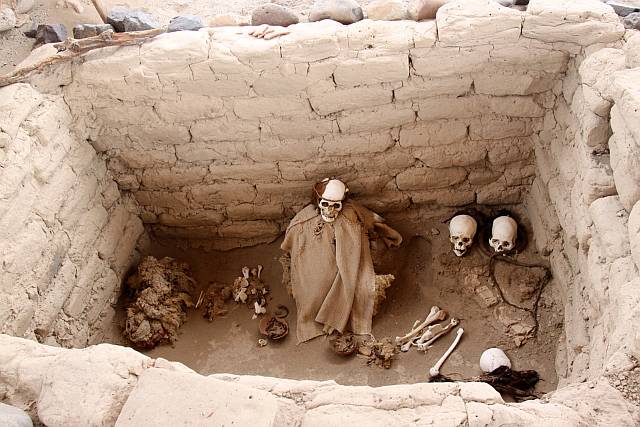
While I have seen skulls & mummies before, most of the time, they are exhibited and protected behind glass under a controlled environment. Here in Chauchilla, they are all placed in a pit which was just surrounded by a simple barrier. A makeshift overhead shelter made up of dried branches complete the "exhibition pavilion". All the mummies are exposed to the environment, but it is exactly the dry climate of the Peruvian desert that had contributed to the amazing preservation state of the mummies!! Of course, the mummification process of the ancient Nazca culture preserved the bodies, but under the desert conditions, there could still be thousand-year-old bodies that had hair and traces of skin intact!


Along with the mummies, bones and skulls, some ancient artifacts were also displayed, but consisted  mainly of broken pottery. Most valuables had been plundered by grave robbers. Apparently, there are possibly a lot more of such mummies that have not been unearthed yet. But for me, the eye opening takeaway, was the amazing state of the mummies in the environment.

Most tourists would have to charter a taxi to get to the Chauchilla Cemetery. But it is easily done before/after the Nazca flight. After all, the flight is just barely an hour..... ;)

Not a tourist attraction for everyone, but interesting nonetheless!

Sunday, August 19, 2012

Life in the Atacama Desert

The Atacama Desert is the driest desert on Earth, and so claimed many sources, including the National Geographic. And so, when I visited it, I was just expecting fantastic and memorable landscapes. But I was pleasantly surprised by how much more Nature provided.


The access town to the Atacama Desert in Chile is San Pedro de Atacama. From there, there are tons of agencies that provide various tours to see the sights around the region. There are also information both in town, and online, that caters to the independent traveler.

I took one of the day tours that visit the 'Altiplanicas' lagoons as well as a salt flat. And at the very first stop (Chaxas Lagoon), I got my first wildlife in the Atacama - pink flamingoes amidst a surreal lagoon. It was indeed a photographic heaven, as these beautiful creatures not only make wonderful subjects themselves, they also add additional interest to the already wonderful landscape and backdrop behind!


As I go further into the Atacama, I soon realized that the inhospitable looking landscape holds many more creatures. And as I mentioned earlier, they can certainly make your images stronger if you can manage to spot them and include them! Guanacos and vicunas are aplenty, and should be easy, but the eagles and the rodents that I manage to see, are alot more difficult to capture, let alone on a shared vehicle day tour! For those on a photographic quest should hire a private vehicle!


Or sometimes,  you could just get lucky, like me. We spotted a South American gray fox who stopped to pose for us! Wonderful indeed. But nevertheless, wildlife or not, the Atacama desert is certainly one of the highlights of Chile and South America even!


Sunday, July 12, 2009

Erg Chebbi

One of my favourite experiences in Morocco was an overnight stay in Erg Chebbi. Situated in/beside the village of Merzouga and Hassi Labied, Erg Chebbi is a sand dune rising 160+m high. Several guesthouses/establishments have setup semi-permanent camp deep into these dunes, and arranging an overnight stay in these is one of the ways to enjoy the magic of the dunes.


Many many guides/agencies are available for arranging trips to the dunes. They are available in the villages Merzouga and Hassi Labied, further in the town of Rissani, and even as far as Er-Rachidia. There are camel treks into the dunes, 4WD and even quad tours into the dunes. However, the quads and 4WDs are pretty noisy, and one of the magic of experiencing the dunes is the serenity and quiet of the place. Most of these seems to operate near the edge of the dunes, so, my recommendation is to spend the night deeper into the dunes, away from the crowd.


I took a camel trek, starting out at 4pm and with a slow ambling walk up into the dunes, you can slowly admire the beautiful golden light play on the curves and lines on the dunes. Before 6pm, I reached our Berber tent, where we view a beautiful sunset over the dunes, and then enjoy our meal of tajine under the cool light of the magic hour. And in the night, you'll experience the surreal tranquility of nature, with barely the sound of swirling sand around you (but not before some hypnotic Berber music from your guide). And whether you sleep in the tent or find yourself lying on a mattress under the star-studded sky, what you would get is a night of the most restful sleep you'll ever get....


Saturday, July 19, 2008

The Gobi

The Gobi Desert, while more well-known in Mongolia, emcompasses both China and Mongolia. The word gobi actually refers to the rocky gravelly terrain and while that covers most of the Gobi Desert, there are other terrain types such as the steppes and the famous sand dunes.


The Gobi is the biggest desert in Asia. Thus travelling in it takes time, and lots of it. Along the way, however, you'll be amazed to see the nomads living in their gher and living in this land for thousands of years. With horses as their main form of transport, and the kind of environment they contend with, you can't imagine the kind of hard life they have been living. And as you stand in the wind swept plains or steppes, you could really imagine the scale, the grandeur, the enormity of the Mongol Horde.


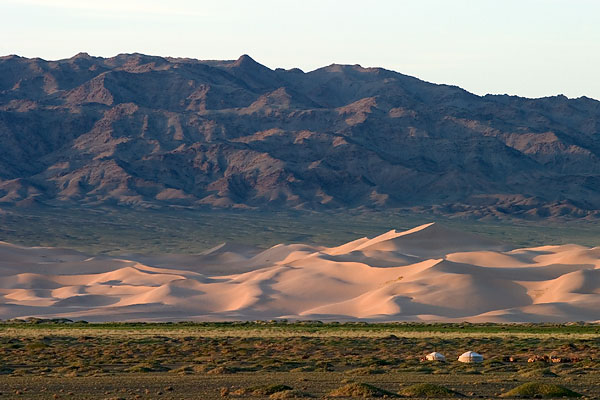
The other highlight of the Gobi Desert would have to be the sand dunes. Being wind eroded, the sand in the sand dunes are extremely fine. I visited one of the sand dunes, known as Khongoryn Els, which stretches 100km long, 20km wide and 800m high! There are many photo ops here, however, do note that because of the conditions, you have to be mindful of a few things :
  • Changing of lens takes extra care. If possible, don't even change lens. If you do, do so within your bag or a trash bag or something. With the slightest breeze, the sand particles will whirl right into your film/CCD/CMOS!
  • Even while taking photos, some photographers enclose their SLRs with rain gear. The sand particles are so fine that they'll squeeze into whatever space they can find. I use my SLR "in the open" and after a while, I can hear grinding sound when I turn my lens zoom! Yes, the sand can even squeeze into that!
  • The sand particles even went into my tripod joints. But unless you don't intend to use the tripod (then don't bring up the sand dune!), then there's nothing much you can do to prevent that. After the trip, my tripod had to undergo "servicing" to remove the sand particles.
  • Exposure wise, nothing really special. Just note that with the shadows formed by the dunes etc can lead to many interesting compositions.
The Gobi is definitely a highlight of a Mongolia trip. Easily seen in any tour package to Mongolia. The difference is how far into the Gobi you want to venture.....